This paper was written and published in 2014.
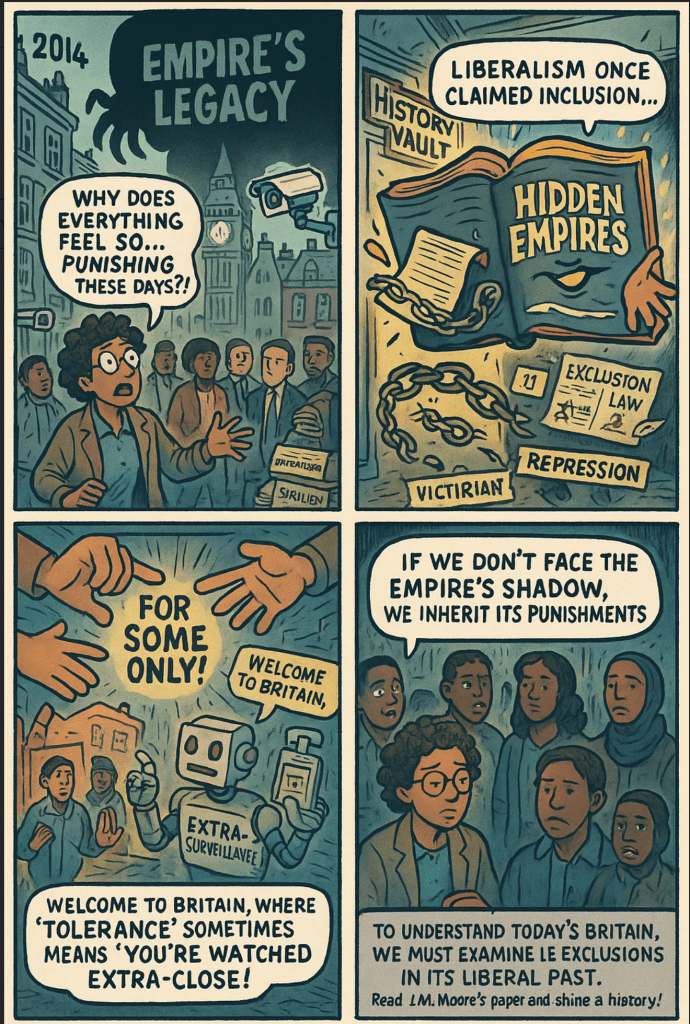
Abstract
The rapid expansion in the use of incarceration and the criminal justice
system’s penetration of new areas of private and public life have been
linked to the emergence of neoliberalism. This expansion of punitiveness
has been portrayed as a reactionary departure from a previously civilising
and progressive social history (Pratt, 2002). Rejecting this view this paper
reconceptualises the British state to include the colonial as well as the
metropole. The first section highlights how the incorporation of colonial
experiences into the history of punishment shows the British state has a
long history of penal excess. In the second section the links between this
colonial history and the ‘new punitiveness’ are investigated and
similarities identified. The final section argues that nineteenth century
liberalism used exclusionary exceptions to reconcile liberty at home with
domination and racism in the colony. The section then explores the
resemblances between this classical liberalism and contemporary
neoliberalism to show how these play a legitimising role in punitive and
exclusionary policies. The paper concludes that the punitiveness currently
being deployed at the metropolitan centre should be seen not as a new
development but as a continuation of punitive strategies that were tested
and developed in the colonized periphery whose subjugated populations’
direct descendants are now among its main targets.
The full paper is available here: https://www.britsoccrim.org/new/volume14/pbcc_2014_moore.pdf
 Trincomalee walks