This short article was drafted in response to a paper titled “A Critical Assessment of the Black Lives Matter Movement in the United Kingdom”, written by Owen Hodgkinson, Luke Telford, and James Treadwell, and published in the Journal of Contemporary Crime, Harm, and Ethics. I came across the article when its understanding of race, racism and its misrepresentations of the BLM movement in the UK was being questioned in a discussion on Twitter. One of the authors, James Treadwell, suggested I write a response in the same Journal and I decided to take him up on his offer. I was not overly hopeful but I do think articles like this needed challenging. Eventually I got a response to my submission – “revise & resubmit” – which I felt was not in good faith for a response paper. But I decided to co-operate and it provided me with the opportunity of polishing up my critique. Subsequently, I have chased up my resubmission with no luck. That is until this week when I was finally advised the Journal had decided to:
“Decline and release your submission. Please note the journal will be closing down effective immediately.”
I was disappointed, but not surprised. I had wanted my reply to appear in the same publication as the original article and therefore maximise its impact in countering the dangerous misrepresentations Hodgkinson et al. made. Hopefully people will help circulate this corrective via social media and course reading lists. In particular if anyone sees the original being posted on social media please reply with a link to this paper.
A pdf version of this paper is available here: A Response to Hodgkinson et al.
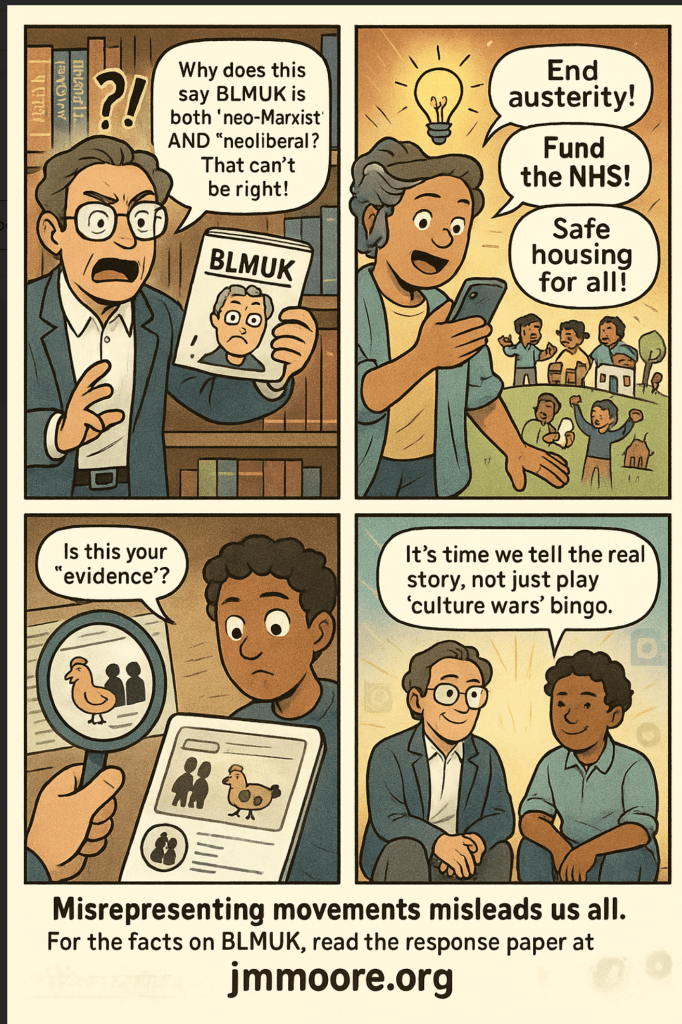
Black Lives Matter: A response to Hodgkinson et al.
In their article ‘A critical assessment of the Black Lives Movement in Britain’, Owen Hodgkinson, Luke Telford and James Treadwell (2021) make a number of claims about Black Lives Matter UK (hereafter, BLMUK) without demonstrating any research into the organisation. Although their article makes one reference to the website of The Movement for Black Lives in the USA (M4BL, undated) it makes no citations from the BLMUK website or only one from other BLMUK publications.[1] The article presents a caricature of the Black Lives Movement in Britain that badly misrepresent both BLMUK and its cause. As a result, there is a real danger that someone reading the article would, if they didn’t know better, gain a very distorted, hostile and inaccurate picture of both BLMUK and the wider issues they campaign on. This needs correcting.
BLMUK was established in 2016 as ‘a member-led organisation’ to ‘fight against racism, but also against capitalism and patriarchy’ (BLMUK, undated A). The organisation’s website states that its members ‘are committed to dismantle class as well as gender and racial domination’ (BLMUK, undated B). It also calls for ‘structural changes to the way our society is set up’ by the adoption of strategies that would implicitly be of benefit to all working-class communities (BLMUK, undated C). To quote directly:
‘We want:
- An immediate reversal of all cuts made during austerity
- Safe, secure, unionised and well-paid green jobs
- Enough social housing built so everyone has access to affordable, secure, decent homes
- Rent controls
- Immediate rehousing of all those effected by Grenfell
- Protect, reinvest and reverse the privatisation of the NHS
- Funding for community and trusts and food co-ops’ (BLMUK, undated C)
Although clearly associated with the 2020 BLM demonstrations that occurred throughout the UK these were not organised by BLMUK, who did however support some of the initiatives of other organisers (BLMUK, undated B). Whilst the Black lives movement in the UK is wider than BLMUK, the group has played a central leadership role in the movement and has been its main spokesperson and fundraiser, raising over £1,200,000 in donations in the months following the demonstrations (Mohdin, 2021).
Whilst no-one would argue for accepting any organisation’s claims uncritically, or that it is not legitimate to challenge them, Hodgkinson et al.’s failure to engage with BLMUK’s stated aims is highly problematic. Either the authors failed to carry out the basic research task of reading the BLMUK website (or any other of their literature), or they did, and then chose to ignore their research. Instead of starting with an evaluation of BLMUK’s claims, Hodgkinson et al., present BLMUK as both ‘a neo-Marxist organisation’ (p. 89) and, simultaneously, responsible for ‘the reproduction of neoliberal ideology’ (p. 98). The identification of BLMUK as neo-Marxist is supported by a reference to an article in The Critic, a ‘contrarian conservative magazine … underwritten by Jeremy Hosking, a Brexiteer investment tycoon’ (Burrell, 2020). The article, by Nick Buckley, a former charity CEO and the Reform UK candidate for the Mayor of Greater Manchester, argues that BLM has ‘a neo-Marxist, anarchist, political agenda’ (Buckley, 2020). It was a conclusion he reached because ‘they put it on their website for the world to read’ (Buckley, 2020). Given the content of BLMUK’s website (see for example BLMUK, undated A, B and C) this is not an unreasonable conclusion, despite BLMUK’s claim that ‘we are not a Marxist organisation’ (BLMUK, undated B).
This critique is developed by the article’s claim that BLMUK activism is intellectually underpinned by Critical Race Theory (hereafter, CRT), a connection which is utilised to attack, by association, BLMUK through the presentation of an inaccurate caricature of CRT. No evidence is supplied directly linking BLMUK with CRT, the link is presumed, and the article relies principally on references to Education Studies to highlight CRT’s influence in the UK. In fact, CRT has had only a limited impact on British scholarship and activism. This is unsurprising given the pre-existence of an extensive body of anti-racist scholarship in Britain, its former colonies and the rest of the world. Any serious scholarly engagement with BLMUK, and the wider campaigns developed, both before and after 2020, in response to racist policing and deaths in custody, would have identified how it was the anti-colonial struggles in former British colonies and the work of scholars like Paul Gilroy, Darcus Howe, Stuart Hall and A. Sivanandan that, rather than CRT, that provide the intellectual base for their analysis of the British state and police (Elliott-Copper, 2021). Much of Hodkinson et al.’s argument, although unreferenced, seems to draw on the discourse of USA right wing think tanks, such as The Manhattan Institute (see for example Rufo, 2020 and Rufo, 2021), which have been imported into the UK by the various think tanks based at 55 Tufton Street (see for example Williams, 2021 and Taggart, 2021) and promoted by right wing conservative politicians as part of their attempt to stoke the so-called “culture wars” (see for example Swerling and Turner, 2022).[2] In this spirit Hodgkinson et al. claim that CRT ‘makes skin colour central, and the value of an argument is judged by the colour of the person making it’ (p. 92). An interesting observation given that a number of the leading exponents of CRT in England are white. The article further argues that CRT (and by implication BLMUK) is compromised by its alleged exclusive focus on race which the article notes ‘is not the only issue that structures social relations and interactions’ (p. 92). CRT makes no such claims. Indeed, in their enthusiasm to misrepresent CRT Hodgkinson et al. have forgotten that a page earlier in their article they had recognised that CRT ‘advocates … analysis concerned with the intersections of race, sex, class and critical pedagogy’ (p. 91, emphasis added). Interestingly they support this self-rebuttal by referencing a paper from Paul Warmington (2020), in which he argues that opposition to CRT is often characterised by an ‘antagonism (which) has an atavistic quality, being rooted in long-standing antipathy towards race-conscious analyses.’
Despite the centrality of class to BLMUK (undated B) Hodgkinson et al. base their argument on the ‘omission of social class from the analyses of BLM scholars and activists in Britain’ (p. 90). It is an invention that they deploy to claim an alleged conflict between race and class which firstly, fundamentally misunderstanding how they are linked (Hall et al., 1978), and secondly, potentially reinforces racist divisions within working class communities. Whilst BLM, BLMUK, British antiracist scholarship and CRT all adopt the concept of intersectionality to explain how race, class, gender, sexuality, and a multitude of characteristics intersect to determine how individuals experience oppression and privilege (see for example, M4BL, undated; BLMUK, Undated B; Hall, 2017; Crenshaw, 1993) Hodgkinson et al. argue that by recognising these multiple facets of identity and then focusing on Black lives BLM, BLMUK and CRT create a conflict of interest between Black Britons and those who they refer to as the ‘native population’ (p. 95). This appears to be an attempt to deploy the “white working class” ‘as a forgotten indigenous constituency’ (Shilliam (2018: 6). However, as Robbie Shilliam (2018: 8) has argued the concept of ‘the “white working class” is an artefact of political domination’; a category utilised to facilitate elites’ management of the British working class. Consistent with this argument, Hodgkinson et al. reject the concept of institutional racism and instead portray racism as being an individual and personal attribute rather than something structural (pp. 98-99). They argue that, in the post war period, ‘immigrant populations experienced racism from parts of the white working classes’ (p. 95). The racism experienced by non-white people in Britain is presented as the fault of working-class people’s prejudice rather than anything structural. This allows the article to not only minimise the impact of racism, but claim it is declining by citing (somewhat dubious) statistics on personal attitudes (p. 89) and a highly partisan Conservative government report (p. 92). The article even crudely misrepresents Martin Luther King’s aspiration of an antiracist future to deploy it in support of a race-blind present (King, 2017).
Although Hodkinson et al.’s caricature of BLMUK and CRT’s understanding of the concept of race relies on arguments directly taken from a neoliberal playbook, they then seek to smear BLMUK for being responsible for the ‘reproduction of neoliberal ideology’ (p. 98). They claim that ‘BLM are not concerned with privilege … they just want individuals to have earnt it’ (p. 98); that ‘it endorses neoliberal ideology’ (p. 101); ‘fails to challenge neoliberal capitalism’ (p. 101); and that it is ‘not against obscene wealth; they simply want black people to have a bigger share of it’ (p. 101). All these claims, and there are many more of them, are made largely without citations or evidence. They are the exact opposite of BLMUK’s stated position and campaigning stances (see BLMUK, undated A, B, & C). To support their argument that BLMUK is pursuing a neoliberal agenda the article rather bizarrely argues that the demand to defund the police legitimises the idea that governments with a sovereign currency need to control public expenditure. Although this is not the place for a detailed critique of Modern Monetary Theory in general (Palley, 2013) or Hodkinson et al.’s particular interpretation of it (pp. 101-102) it is worth highlighting how the economic policies of the recent Truss Government in the UK demonstrates its limitations.[3]
By seeking to locate Black Lives Movement as a phenomenon originated in the USA, whose analysis and demands do not translate into the British context, Hodkinson et al. attempt to delegitimise concerns about Black lives in the UK and the campaigning of BLMUK. However, they seem unaware that Britain already had long established campaigns around policing and deaths in custody that were largely (but not exclusively) Black led. The extent of campaigning around police violence and racism in the early 1980s can be seen through the Metropolitan Police Special Branch monitoring of them (Special Branch, 1983). More recently, the United Friends and Families Campaign (UFFC) has actively campaigned on deaths in custody since 1997 (UFFC, undated).[4] Whilst the slogan Black Lives Matter was new (and too good not to be adopted and deployed in the UK) the idea that the state and its criminal justice institutions did not value Black lives was well established (Howe, 2020). In reality BLMUK is not an imported USA franchise but the continuation of long-established campaigns in the UK. To claim, as the article does, that BLMUK asserts ‘that the CJS in Britain is a mere imported version of the USA’ is to ignore how BLMUK draws on the substantial body of anti-racist scholarship that directly addresses the particular history (and racism) of the British Criminal Justice System (Elliott-Copper, 2021). Far more seriously, it is gaslighting the experiences of Black and other non-white people. Their direct experience of British policing meant that the relevance of the Black Lives Matter slogan to the UK was immediately obvious.
Hodgkinson et al. also argue that whilst USA policing may be linked to colonialism and slavery, this is not true of British policing. In terms of the history of slavery they claim that ‘white Europeans captured African people and sold them as slaves mainly to the USA’ (p. 93). This distancing of Britain from the history of slavery not only fails to acknowledge that what is now the USA was established by Britain as a settler and slave colony, but also that Britain was the major trans-Atlantic transporter of enslaved Africans (Olusoga, 2016). In fact, the USA was a relatively minor Atlantic slave trade destination with some 95% of enslaved Africans being landed in the Caribbean or South America (Eltis and Richardson, 2010). They claim that whilst USA policing was ‘largely influenced by the transatlantic slave trade’ the ‘UK’s post-war policing culture regarding racial perception … was largely shaped by the Windrush generation’ (p. 95). In reality British policing developed as a global enterprise which, as well as policing the metropole, involved the policing of settler, slave and extractive colonies (Anderson and Killingray, 1991). Ideas, strategies, techniques and practices of British policing, some of which have only relatively recently been experienced in Great Britain, were developed across the British empire (Moore, 2014). British non-white people moving to the metropole from the colonies – before, during and after the Windrush era – brought with them lived experience of British policing as well as traditions of resistance to its racism and violence (Elliott-Cooper, 2021).
In a pre-emptive attempt to dismiss any critique of the article Hodgkinson et al. suggest any criticism they receive will be ‘because we are three white, male academics’, rather than because of any weakness in their arguments (p. 92). This is passive-aggressive nonsense, it is the article’s misrepresentation of BLMUK (and CRT), historical errors and superficial understanding of racism, rather than its authors’ identities, which are the issue. Whatever they may claim, BLM is not about them, or me, or any other white person. BLMUK are part of the tradition of Black led resistance to the long history of British racism which continues today, with non-white people, and in particular Black boys and men, being disproportionally stopped and searched, arrested, imprisoned and killed by the British criminal justice system. Black lives, in Britain today, continue to matter less. I hope that this response will correct some of the misrepresentations in Hodgkinson et al.’s article and limit the damage it potentially does to the ongoing struggle to make Black lives as valuable as white lives.
References
Anderson, D. and Killingray, D. (1991) Policing the Empire: Government, Authority and Control, 1830-1940. Manchester: Manchester University Press
BLMUK (undated A) ‘Our Movement’ Black Lives Matter UK, online at https://ukblm.org/about/ (accessed on 10 February 2023)
BLMUK (undated B) ‘FAQ’ Black Lives Matter UK, online at https://ukblm.org/faq/ (accessed on 10 February 2023)
BLMUK (undated C) ‘Our Platform’ Black Lives Matter UK, online at https://ukblm.org/demands/ (accessed on 10 February 2023)
BLMUK (undated D) ‘BLMUK Fund’ Black Lives Matter UK, online at https://ukblm.org/blmuk-fund/ (accessed on 10 February 2023)
Bright, S. (2022) ‘They Wanted to Blow Up Britain’s Economy, and Liz Truss Let Them’ New York Times 6 October 2022 online at: https://www.nytimes.com/2022/10/06/opinion/truss-kwarteng-uk.html (accessed on 10 February 2023)
Buckley, N. (2020) ‘Why Black Lives Matter are so dangerous’ The Critic 16 July 2020 online at: https://thecritic.co.uk/i-was-fired-for-criticising-blm/ (accessed on 10 February 2023)
Burrell, I. (2020) ‘Does Britain need another contrarian conservative magazine?’ The Drum 30 January 2020, archived online at https://archive.ph/KjJy6 (accessed on 10 February 2023)
Crenshaw, K.W. (1993) ‘Beyond Racism and Misogyny: Black Feminism and 2 Live Crew’ in Mastuda, M.J.; Lawrence, C.R.; Delgado, R. and Crenshaw K.W. Words That Wound: Critical Race Theory, Assaultive Speech, and the First Amendment, New York: Routledge
Elliott-Cooper, A. (2021) Black Resistance to British Policing, Manchester: Manchester University Press
Eltis, D. and Richardson, D. (2010) Atlas of the Transatlantic Slave Trade, New Haven: Yale University Press.
Hall, S., Critcher, C., Jefferson, T., Clarke, J. And Roberts, B. (1978) Policing the Crisis: Mugging, the State, and Law and Order, London: Macmillan.
Hall, S. (2017) The Fateful Triangle: Race, Ethnicity, Nation, Cambridge: Harvard University Press
Hodgkinson, O., Telford, L., & Treadwell, J. (2021). A Critical Assessment of the Black Lives Matter Movement in the United Kingdom. Journal of Contemporary Crime, Harm, and Ethics, 1 (1), pp.88-107
Howe, D (2020) From Bobby to Babylon: Blacks and the British Police, London: Bookmarks Publications
Joseph Salisbury, R., Connelly, L. And Wangari-Jones, P. (2021) ‘“The UK is not innocent”: Black Lives Matter, policing and abolition in the UK’, Equality, Diversity and Inclusion, 40 (1) pp. 21-28
King, M. L. (2017) ‘I have a dream speech’ YouTube, online at: https://youtu.be/vP4iY1TtS3s (accessed on 10 February 2023)
M4BL, (undated) “Vision for Black Lives’ Movement for Black Lives website, online at https://m4bl.org/policy-platforms/ (accessed on 10 February 2023)
Mohdin, A. (2021) ‘Black Lives Matter UK to give £600,000 in funding to campaign groups’, The Guardian, 18 February 2021, online at: https://www.theguardian.com/world/2021/feb/18/black-lives-matter-uk-to-give-600000-in-funding-to-campaign-groups (accessed 10 February 2023)
Moore, J.M. (2014) ‘Is the Empire coming home? Liberalism, exclusion and the punitiveness of the British State’, Papers from the British Criminology Conference, Vol. 14 pp.31-48 online at: http://www.britsoccrim.org/new/volume14/pbcc_2014_moore.pdf (accessed on 10 February 2023)
Olusoga, D. (2016) Black and British: A Forgotten History, London: Macmillan
Palley, T.I. (2013) ‘Money, fiscal policy, and interest rates: A critique of Modern Monetary Theory, IMK Working Papers, No. 109, online at https://www.econstor.eu/bitstream/10419/105973/1/imk-wp_109_2013.pdf(accessed 10 February 2023)
Rufo, C.S. (2020) ‘The Truth about Critical Race Theory’, Wall Street Journal, 4 October 2020, online at: https://www.wsj.com/articles/the-truth-about-critical-race-theory-11601841968 (accessed 10 February 2023)
Rufo, C.S. (2021) ‘Battle over Critical Race Theory’, Wall Street Journal 27 June 2021 online at: https://www.wsj.com/articles/battle-over-critical-race-theory-11624810791 (accessed 10 February 2023)
Shilliam, R. (2018) Race and the Underserving Poor: From Abolition to Brexit, Newcastle upon Tyne: Agenda Publishing
Special Branch (1983) ‘Political Extremism and the Campaign for Police Accountability within the Metropolitan Police District’, Undercover Policing Inquiry, online at: https://www.ucpi.org.uk/wp-content/uploads/2023/01/MPS_0748355.pdf (accessed 10 February 2023)
Swerling, G. And Turner, C. (2022) ‘Teaching of race ideology in schools is ‘absolutely terrifying’ warns minister’, Daily Telegraph, 17 March 2022, online at https://www.telegraph.co.uk/politics/2022/03/17/ethnic-minority-success-stories-must-acknowledged-says-minister/ (accessed 10 February 2023)
Taggart, J. (2021) ‘Critical Race Theory (CRT) illustrates the “Law of the Instrument”’, Institute of Economic Affairs, online at: https://iea.org.uk/critical-race-theory-crt-illustrates-the-law-of-the-instrument/ (accessed 10 February 2023)
UFFC (undated) ‘No Justice, No Peace’, United Families and Friends Campaign, online at https://uffcampaign.org (accessed on 10 February 2023)
Warmington, P. (2020) ‘Critical Race Theory in England: impact and opposition’, Global Studies in Culture and Power, Vol. 27, No. 1, pp. 20-37.
Williams, J. (2021) Rethinking Race: A critique of contemporary anti-racism programmes, London: Civitas
FootNotes
[1] The only reference to a BLMUK source is a screenshot of a tweet from the organisation remembering the anniversary of Belly Mujinga’s death which contained a graphic listing people who died in prison, a graphic whose inclusion of Fred West (who died in prison) they highlight.
[2] I am not suggesting that the specific articles I cite in this sentence are the direct source of Hodgkinson et al.’s arguments. Rather that they illustrate that their ideas are, consciously or unconsciously, drawn from a discourse that starts in neoliberal think tanks in the USA, before being imported into the UK by Tufton Street think tanks, and then promoted by right-wing politicians whose interventions have led to it being disseminated through both print and online media.
[3] It is somewhat ironic that the Truss/Kwarteng experiment of unfunded public expenditure/tax cuts was inspired by the same Tufton Street think tanks (Bright, 2022) whose critique of CRT and BLM underpin Hodkinson et al.’s understanding of race and racism.
[4] UFFC were the only organisation specifically named by BLMUK on their GoFundMe page illustrating the close links between the two organisations (BLMUK, undated D).
 Trincomalee walks